In 2018, Hamilton police responded to more than 3,000 alarms. Ninety-five per cent were false, according to Hamilton Police Service. Halton police have put their figure at about 98 per cent, as BurlingtonToday reported.
Numbers like these are why most Ontario police services now require alarms to be verified before officers are sent. They are also why monitoring operators, security managers and plant teams can lose faith in their own systems. When the phone rings at 3 a.m. for the fifth time in a week because of a swaying tree, people stop treating alerts as urgent.
Video analytics were supposed to fix this. Done well, they do. Done poorly, they just create a new kind of noise.
Why Do Industrial Sites Generate So Many False Alerts?
Large industrial sites are tough environments for automated detection. Common culprits include:
-
Headlights sweeping across fences and yards at shift change.
-
Rain, snow, blowing leaves and fog in front of the lens.
-
Spiders and insects building webs near infrared illuminators.
-
Animals, from deer at rural plants to gulls at ports.
-
Vegetation, flags and tarps moving in the wind.
-
Shadows and lighting changes at dusk and dawn.
Older motion detection simply reacts to changing pixels. It cannot tell a person from a plastic bag. Modern analytics classify objects, but they still need careful setup to work in an Ontario winter.
What Does a False Alarm Actually Cost?
Direct costs are easy to see. York Regional Police, for example, charge $240 plus HST for an attended false alarm, according to its Verified Alarm Response Program. Monitoring contracts often charge per event, and guard callouts add up quickly.
Indirect costs are bigger. Operators get alert fatigue and start dismissing real events. Security teams lose credibility with operations. Police response can be slowed or suspended for chronic offenders. And when a real intrusion happens, it may be buried under 40 nuisance alerts.
How Does Reducing False Alarms With Video Analytics Work?
Reducing false alarms with video analytics is less about buying a smarter camera and more about tuning the system to the site. A practical approach looks like this.
Choose the right sensor for the zone. On long perimeters, thermal cameras usually outperform visible cameras for detection, because they see body heat and ignore headlights and shadows. Visible cameras work best for identification and verification.
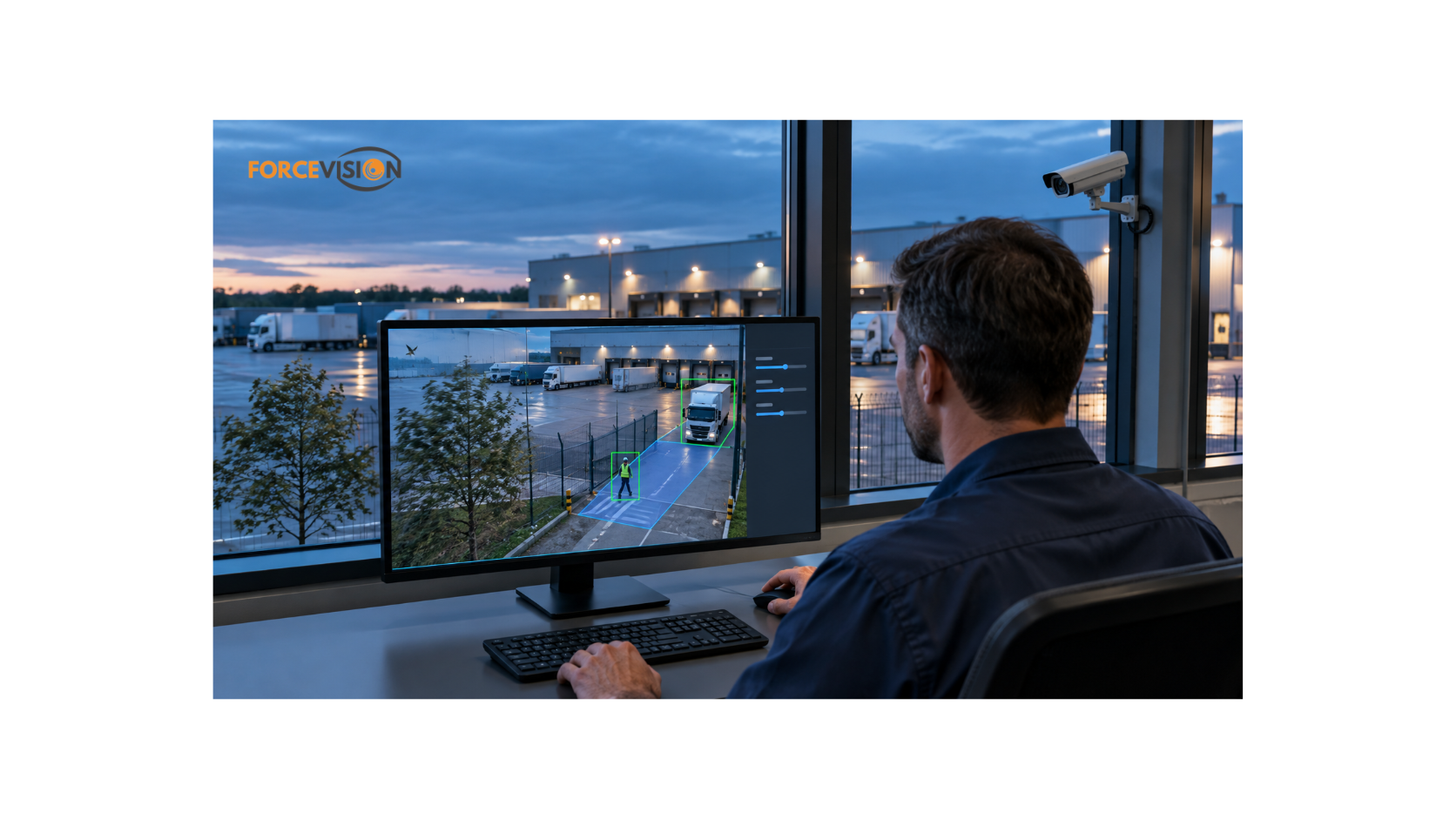
Use object classification. Configure rules to alert only on people or vehicles, not “any motion.” Most current analytics can distinguish humans, vehicles and animals with good accuracy when cameras are placed correctly.
Draw smarter zones. Keep detection zones away from roads, trees and flagpoles. Use direction-aware line crossing, so a person walking along the fence outside does not trigger an alarm, but one crossing inward does.
Set size and dwell filters. Minimum object size filters out birds and small animals. Short dwell or loitering times help separate a passing truck from someone lingering at a gate.
Schedule by operations. A dock may be busy until midnight and empty afterwards. Arm rules according to real shift patterns, not a single “after hours” setting.
Correlate with other sensors. Two independent signals, such as a fence sensor and a camera classification, give much stronger confidence. Hamilton police accept multiple activation points as one way to verify an alarm, as the police service explains.
How Should Teams Review and Retune Over Time?
Analytics are not “set and forget.” The best-performing sites run a simple review loop:
-
Track alerts per camera per night.
-
Every week, review the top five noisiest cameras.
-
Classify each false alert by cause: weather, animals, lighting, vegetation or setup.
-
Adjust zones, filters or camera angles.
-
Retest at night.
Plan seasonal retuning too. The first snowfall, leaf fall and the switch to standard time all change how a scene looks to an algorithm. A camera tuned in July can misbehave badly in November.
Maintenance matters as well. Clean lenses, clear vegetation and remove spider webs near IR illuminators. Small physical fixes often cut more false alerts than software changes.
Can Analytics Help Operations, Not Just Security?
Yes. Once a site trusts its analytics, the same tools can count trucks at gates, measure queue lengths at docks, track dwell times in yards and flag people in restricted areas near moving equipment. Those insights help operations and safety teams, and they spread the cost of the system across more of the business.
ForceVision helps large industrial operators across Southern Ontario design, tune and maintain analytics-based camera systems, from 64-camera plants to multi-site logistics networks. If your team is drowning in nuisance alerts, we can review your configuration and suggest practical fixes.
The Takeaway
Pull last month’s alert log and find your five noisiest cameras. If you cannot explain why they alert so often, start there. Reducing false alarms with video analytics begins with a single camera and a willingness to tune, test and repeat.
FAQ
Q: Why do Ontario police require alarm verification?
A: Because the vast majority of alarms are false. Services like Hamilton and York require verification, such as video, audio or multiple sensor activations, before dispatch.
Q: Are thermal cameras better for reducing false alarms?
A: On perimeters, often yes. Thermal cameras detect heat signatures and are less affected by headlights, shadows and darkness than visible cameras.
Q: How often should video analytics be retuned?
A: Review the noisiest cameras weekly and retune seasonally, especially after the first snowfall, leaf fall and clock changes.
Q: Can analytics serve operations as well as security?
A: Yes. The same system can measure truck queues, dock dwell times and restricted-zone entries.